Saturday, January 24, 2015

Another Test for the President: Jokowi's Jinks

http://www.thejakartapost.com/news/2015/01/27/your-letters-a-test-president.html

It's Gecko vs. Crocodile all over again. Only now its escalation and impact will affect the fate of the new President who neither firmly secures political nor military backing. His response in dealing with this crisis is vital for his survival. He won in the Presidential race due to massive public support, believing he could bring changes despite having humble background and estrangement from the elite and military. Taking the wrong step, he would surely lose the public's trust and support. A former furniture salesman from outside the political establishment, Jokowi is deemed to have a proven track which is critical to carry out the reforms he has promised to deliver. But his indecisiveness over the battle of KPK vs. the Police is the first blot on his leadership. Without public backing, his government would be in limbo.

In the prolonged epic battle between the Indonesian graft- busters and the national police force, the silent war climaxed in the arrest of the Deputy Chief of the Corruption Eradication Commission (KPK), Bambang Widjojanto. Again the two forces are locking horns. A gecko, or cicak, is pitting itself against the crocodile, or buaya. Just 10 days after naming the presidential nominee, Lt. Jend. Budi Gunawan, the former adjutant of Indonesian Democratic Indonesia of Struggle (PDIP) patron, as the next national police chief a suspect of taking bribes, the KPK deputy head was taken into custody for alleged false testimony when he was dealing with a regional election dispute as a lawyer before a court in 2010.

One cannot help to think that the arrest is politically motivated. Budi Gunawan, now the head of police training, is popular with the political elite and is close to former president Megawati Sukarnoputri, the chairwoman of PDIP who backed Jokowi's nomination in the previous presidential race. Many suspect the nomination was deferring to his patron by promoting Gunawan whose suspicious bank balance the KPK began to investigate back in 2010. And the President has bowed down under pressure. So to speak, the arrest is seen as an aggressive retaliation against KPK from the Police and PDIP.

Amid the mounting outcries from the public and netizens alike for the President to intervene, given he is the supreme leader of these two law enforcers, the President has distanced himself from the intensifying tension. In a statement to address the ongoing crisis, the President only asked the police and KPK to ensure that the process of the law is objective and to avoid any frictions as they carry out their respective investigation. To the dismay of the people, this statement seemed offer no resolution but let the dice kept rolling wildly.

As a result, the unclear stance put the nation in dire situation. This political brouhaha stems from Jokowi's blunder to nominate Budi Gunawan for the top job in the national police as the sole candidate albeit his being red-flagged by the KPK. Perhaps, Jokowi hoped that parliament might veto Gunawan’s appointment in an elegant move to reject the nomination without offending his patron. But the opposition-controlled legislature mischievously declared Gunawan to be fit to lead the police. Forced to choose between snubbing Megawati or his own volunteers, Jokowi dithered again. In a televised address to the country he said that he had postponed Gunawan’s appointment, but not “cancelled” it. This has started the guerilla war of the two law enforcers.

Logically speaking, the public has every right to demand the President resolve the problem without creating further rift in the corps. But it seems the situation gets out of control and escalates. One by one, other KPK commissioners are being brought into spotlight. Allegation after allegation rained down the KPK from those who gain benefits from the weakening corruption body. What infuriates us further is the report that put Bambang Wdjojanto into custody came from a person who has past human rights violation, mutilating and torturing environmental activists. This is just so absurd!

We watch this drama with hammering heart, waiting for the final chapter unfolded. We demand the President to take bold action to stop the systemic weakening of the anti graft body.

However, having no strong military as well as political backing gives a hellish battle for President Jokowi. He is likely forced to make closed door decisions and backroom dealings. Relying on public support will not forever secure him the necessary power to navigate his ship to avoid turbulence and dark waters. The military remains powerful with its own strong patronage. While the political parties will always be loyal only to those who offer more priviliges and benefits. Without smart elegant moves, Jokowi will be attacked from all direction, a hostage to the political bickering of the elites.

Jokowi might be popular and has the unprecedented public support. Yet, his popularity might wane if he makes too much compromises and backroom dealings to please all but the people. It should be the people's and nation's interest that should come first. At the start of his five-year presidency, with many battles still to fight, he may need to remember that his true allied are his popular supporters, and not Megawati or PDIP who only endorse him reluctantly.

Now, all eyes are on the President's every move. Resolving the current crisis will prove an early test for Jokowi, who took office in October pledging a clean government, and support the corruption eradication that plauges the nation for far too long.
Top of Form


Tuesday, January 13, 2015

Killing Is Not the Way of Islam

http://www.thejakartapost.com/news/2015/01/19/your-letter-killing-not-way-any-religion.html

Killing is not the Way of Islam

As the masked terrorists sauntered towards the already wounded police officer at the sidewalk, I stopped breathing. In cold-blood, the gunmen executed him at point blank range. The graphic images were extremely shocking. I had to stop my dinner as my stomach churned. The disturbing nature of the video was sickening. So was the act of killing in the episode. Those criminals cannot be true believers of any faith.

The deadly attack on the Paris office of French satirical magazine Charlie Hebdo has left 12 people dead, and five more in critical condition. Regardless of the rights and wrongs of Charlie Hebdo’s content, much of which I personally found grossly offensive, it is not right to justify the killing spree. It’s a bloody cowardly act to shoot unarmed defenseless innocents. It’s a barbaric crime and its perpetrators should be held accountable for it.

What I find it grossly nauseating is upon the bloody carnage, these gunmen shouted “God is Great”, saying that they have avenged the Prophet. What an idiotic and deranged idea! It is not the Prophet who was avenged. On the contrary, it is Islam with all its values and principles that have been hijacked and defiled. I found myself boiling with absolute rage to see them kill in the name of the Prophet. Such crimes against humanity are never justified by either Islam or any other religions. Under no circumstances does Islam allow vigilante justice to open door leading to chaos, confusion and bloodshed.

It is true that Muslims all around the world are deeply offended and hurt by the published anti-Prophet cartoons under disguise of freedom of expression. We are saddened by the growing of Islamophobia and anti Islam in the West which plunge the society at large into opposite polarization. But it is not a valid excuse to go on a killing rampage. We are already aware that insults and defamation have been directed to the Prophet during his life and likely to continue after his death. They will never stop.

In this regards, The Prophet has set up noble example in dealing with such crisis. He was constantly verbally abused and physically harassed during his stay in Makkah. Yet, never ONCE did the Prophet raise his hands or throw words of hatred to his tormentors. He was the first to stop any of his companions who want to avenge such deeds. Instead, he repaid the wrongdoings with compassion, mercy and forgiveness. Hatred begets hatred and violence likewise.

So, it is exceedingly appalling to learn that these culprits kill others in the name of the Prophet or Islam. What a total madness to believe that they love The Prophet more than his companions and defend Islam more than the Prophet and his companions. Such despicable acts were not parts of Islam whatsoever.

In fact, their terrible crimes have encouraged the new racism in Europe, namely Islamophobia as its quick response. With alarming results, we have seen the rise of anti-Islam across Europe. Muslims are singled out for the assault. The defamation of The Prophet reprinted in millions copies and spread worldwide through social media. And the vicious circle repeated.

Therefore, it is tremendously stupid to ever think that murder and terror can stop people from offending our faith. It only aggravates the assault and put the livelihood of all Muslims around the world on the brink of chaos.

Instead of spreading horror and terror, the appropriate response to any provocation is through thought, art, opinion and deeds that reflect true believers. It is more productive to work towards common goals to promote peace, greater tolerance and love among men regardless of creed or color.

Again, on the bloody attack of the Charlie Hebdo, Muslim communities all over the world share the pains and sadness with the victims’ families and friends. Our hearts bleed for their loss and pains.

And we hope that politicians and media will not use this incident to make wrong generalizations against Muslims.


Tuesday, December 30, 2014

Women's Empowerment to End Poverty


http://www.thejakartapost.com/news/2015/01/09/your-letters-empower-women-end-poverty.html

Mother's Day is a day which celebrates life, continuous giving and a stream of unconditional love. It is a day when we celebrate the tremendous value of Mother who has given us life and nurtured us to becoming the man or woman we are today. Most mothers have an undying and unconditional love for their children in good times and in bad times, never expected anything in return. Her traditional role, as the nurturer and caretaker has existed since the beginning of time. But as time clocks in, her role has evolved to include either the primary or co-breadwinners of their families.

As in the case with my Mum, she helped to support my father's meager income to finance their kids for college. Most mothers in my village have such role due to their poor economics background. Mostly, they are working at the nearby garment factories and the tofu home industries or any other unskilled labors with only minimum basic salary. Limited education due to financial constraints denied them to land in jobs with better payment. Their husband suffer the same fate of registering into menial jobs only to live hand to mouth. Their economic advancement is having snail like pace if anything.

Impoverishment thus results in their younger generation to receive inadequate education as the cost of getting good education keeps skyrocketing. The poor could not afford to go for college due to its growing commercialization. Consequently, these younger generation go on to repeat the same cycle as their parents did. They could only finish their high school. With such qualification, the only option available is working as with their parents in factories with minimum pay, and the vicious cycle is repeated.

Mostly, they are women that dominate the lowest skilled jobs, working in precarious, insecure, and exploited jobs, such as domestic helpers particularly migrant workers or in the manufacturing industries (mostly garment, textile and electronics).These women are already doing it all — working hard, providing, parenting, and care-giving. Tragically, their families can’t prosper, and that’s weighing the Indonesian economy down.

When women are poor, their rights are in grave danger. They would face obstacles that may be extraordinarily difficult to overcome. This results in deprivation in their own lives and losses for the broader society and economy, as women's productivity is well known as one of the greatest generators of economic dynamism.

Statistics shows that women make up half of the world's population and yet represent a staggering 70% of the world's poor. For the millions of women living in poverty, their lives are a litany of injustice, discrimination and obstacles that get in the way of achieving their basic needs of good health, safe childbirth, education and employment. This includes Indonesia in which regional gender biased bylaws are targeting women, giving a silent stamp for women as less worthy than men. Thus, it worsens the condition of women in general and in return poverty remains in their circle. The sequence of discrimination that a woman may suffer during her entire life is unacceptable but it takes place almost all around the world.

For this reason, on Mother's Day, we have to reflect on this vital issue that direly affects women' life. We have to be aware that we live in a world in which women living in poverty face gross inequalities and injustice from birth to death from poor education to vulnerable and low pay employment. Therefore, women's empowerment is imperative, specifically for housewives so that they become economically independent to end women’s poverty and providing better economic opportunities.

The best policy solutions to address women’s poverty must combine a range of decent employment opportunities with a network of social services that support healthy families, such as quality health care, child care, and housing support. It is equally vital as well to stop gender biased regional bylaws which castrate women's basic rights and liberties. Government should also actively engage to elevate the condition of women by providing regulations which support women empowerment such as by supporting banking laws which provide greater access for women to start their independent business as in Grameen Bank Program in Bangladesh that makes small loans to the impoverished without requiring collateral.

Sunday, December 28, 2014

Ode to my Dad

All of us will experience loss during the course of our lives, be it someone dear to you in your family circle or friends. It is the death of a parent, however, that comes with an especially keen edge that makes a ragged cut. And that cut is slow to heal.

I lost my Dad recently – a little more than a week ago – and it was a hard shot to take. My Dad had suffered a stroke a year before and he became ill for some time. Despite our physician's verdict that he would be unable to walk again and be confined to bed only, he beat the odds. He walked again although it was not like the way he used to be. His memory thank God functioned well after his brain hemorrhage. It was only his physical strength and emotion that suffered a damage.

Each week afterward he seemed to get better in spite of some minor relapses. He could even carry my 11 months old nephew at his back. When he prayed at our little musholla (praying place smaller than mosque), this little boy would climb at his back and tucked at his hair. He would then gently lift him up and continued the ritual while watching over this little lad. So, I was not prepared of what was coming.

I know he would be gone someday as he aged. Afterall, death is the destination we all share. It is the one thing we can be certain about in life. Yet, I still cling to the belief that we would still have more years to spend. And this prolonged period was sufficient until I relocated to my hometown. I was wrong. Death is indeed only a whisper away.

The knowledge of the inevitable end provided no armor against the wound of his loss. I was still at my home in Jakarta to get ready to fly to Solo when my dad passed away. The last phone call I made to him lasted only a few seconds as he groaned in terrible pain. I tried to talk to him although he was well beyond hearing anything I had to say at that point. Then the phone went dead. Those last few moments, as important as they were, were not vital to the heart of our relationship. I’d said everything I really needed my Dad to know long before the day of his death, and there was nothing left to do but love him as he died.

However, I should have come home sooner. A pang of guilt washed over me.
The loss felt deeper when our relatives left the house after the funeral. This deep regret keeps tucking at the strings of my heart. How could I sleep well on the night he suffered the most painful agony; when the Angel of Death came uninvited to his bed? My tears could not ease this weight on my chest.

I sat down and started to write a couple of times, but always failed halfway through the first line. How was I going to tell the world how I felt about my Dad? It is as simple and beautiful as wild flowers on the mountain, yet words seem fail to capture its complicated simplicity. I wondered as I stared, first at my blank screen, then at my blank piece of paper, then again at the cruelly blinking cursor. How was I possibly going to describe the love I had for him, and the way his loss affected me and my family. I wracked my brain for several days to pour my heartfelt sorrow in a piece of paper. I tried to employ my craft to honor my Dad when I felt his loss most keenly. He had been such a big part of my development as a person that it broke my heart to think I might fall short and screw up his memory.

My dad had such a big personality. And I didn't think writing his best resume on a piece of paper would do him justice. I know that he had lived his life at the fullest, knowing that his presence had touched the lives of the people he met and those around him. I know that even his 'enemies' had fears for his stern conviction of the truth and justice. I know as well that his less unfortunate neighbors and friends respect him out of his affectionate heart. He can be as gentle as summer breeze and as fierce as the thundering winter wind. And he will be sorely missed either by friends and foes.

At the end, it is with a smile I bid farewell to my Dad before leaving for Jakarta, knowing that he was loved by all. As the sweet fragrant of roses' petals and jasmine on his fresh grave floated in the air, I know that he is now at peace in the realm of angels.


Wednesday, December 17, 2014

Education is Every Children's Rights

"Dear sisters and brothers, the so-called world of adults may understand it, but we children don't. Why is it that countries which we call strong" are so powerful in creating wars but are so weak in bringing peace? Why is it that giving guns is so easy but giving books is so hard? Why is it, why is it that making tanks is so easy, but building schools is so hard?"

As Malala Yousafzai delivered her Noble Lecture live on my TV Screen, I listened at all ears. As the youngest noble laureate in all history, she gave a powerful speech arresting in its utter straightforwardness. It was simple, yet so powerful. It moved my heart. I am so glad me to see her accepting the Nobel Peace Prize with Kailash Satyarthi, the Indian children’s rights advocate. But it also brings pain to learn that many children especially girls could not enjoy education. It is even sadder to know that they are deprived of such basic privilege mostly due to social taboo and misguided religious interpretations.

Sadly, but truly, women and girls have been victims of ruthless power struggles for centuries in all societies and cultures around the world. Throughout history, many pious individuals have pondered their relationship with God only to end up with a program of hatred, murder, misogyny, bigotry or child abuse. The world seems to conspire in exercising the patriarchy in different forms such as the denial to education, unequal salaries compared to men in workplaces, forced marriages and prostitution, among many others.

It is exasperating to continue hearing news on how group of individuals or a bunch of the so called 'religious clerics' use religion to rob girls of education, saying it is forbidden and deemed as seed of evils! Gee, I can’t help thinking what a stupid shallow baseless argument they draw on. Are they playing God? Worse, are they idiotically personifying themselves above God and the Prophet? It is so maddening. Reasoning with them is just like hitting a concrete wall.

As if history repeated all over again, just days after we rejoiced in Malala’s speech and tried to work the dream alive, the world is shocked by the deliberate killing of innocent people at an army-run school in Peshawar by Pakistani Taliban militants, killing 141 people, 132 of them children. On that fateful day, many Malala died when they were at school. In a place where knowledge should have flourished, these kids were brutally exposed to violence, vengeance and horror. The gory details as recalled by the survivors made our stomach to churn and our core rocked with unspeakable rage. The grotesque massacre was a message to discourage Malala and her supporters in advocating education for women or children.

What madness drove these beasts to unleash their senseless brutal attack to the innocents? Militants have perpetrated extreme violent acts in the name of religion – whether it be Christianity, Islam, Judaism, Hinduism or another faith throughout history. This has emphasized that terrorism cannot and should not associated with any religion, nationality or civilization. We must thus avoid the temptation to be simplistic that all religions are the source of the problem.

So to speak, these are not the act of group of religious people. This is an act of Godless people. Violence is their faith. Dead and blood are their rituals. Hatred is their burning fuel for existence. To spread fear and terror is their sole goal. And they will not stop until their objective is achieved.

This abominable slaughter could only have come from the hands of evil, deploying those who have given themselves over to wickedness, to commit this dreadful thing. No logic reason can justify what was done except that these militants have again shown their lust for innocent blood and their disdain for a peaceful life. They intimidate, terrorize and kill Muslims, Christians, and other faiths alike and spread wanton destruction. They bow to nothing but their own ego.

Thus, the people all around the world, regardless of race, color or religion must stand arm in arm to tackle this terrorist onslaught. Only if we unite, will this terrorist machine and those behind it be defeated. We have to stand firm to acknowledge that no one has the right to deny a boy or a girl their education. We have to uphold the justice that without education, one will face limited prospects, have decreased family income and reduced health. Lack of education will also put women and girls of trafficking and exploitation and limits the economic advancement of the entire countries.

We also have to unite to say NO to violence in resolving any conflict. We have to promote peace and love as the antidote of war and hatred.

In view of this, we must learn to be good to each other, be tolerant and respectful to strive for a vision of harmony. Our race should outgrow the barbarism of ignorant beasts in a world where growing intolerance carries a forbidden fruit that might open the Pandora’s box.


Saturday, December 13, 2014

Cutting Women's Work Hour: The Stepford Wives Ideal

http://www.thejakartapost.com/news/2014/12/17/your-letters-cutting-against-grain.html
The idea of cutting working hours for women shorter than their male counterparts seems a rash thoughtless idea. To think that the reason behind the careless statement by VP Jusuf Kalla is to offer an opportunity for women to care more for their children and family as their traditional role is even irksome. Noble it might be, yet it amplifies the mainstream idea that the duty to look after the kids and family is reserved only for mothers and fathers as a happy go lucky party. It’s like watching “The Stepford Wives” movie in which the men take the role of traditional wife very seriously. Men need to realize women are not something they can mold into their perfect housewife.
 As a woman myself, I beg to disagree with the idea. The policy might be seen as a strategy to increase women’ productivity as employers often cite child-care issues as causing more problems than any other family-related issue in workplace which increases in absenteeism and tardiness. Accordingly, it seems logical to provide women a way to allocate more time with their family. However, I do not think such policy can address the problem properly; instead it might escalate the problem. Worse, it will be burdensome for women instead. My opinion stems from three basic reasons.
First, we live unfortunately in a society where both parents have no choice but to work full time in order to make ends meet. If the responsibility to raise a child properly lies in both parents, a father and a mother, then the question is why men are not entitled the same right to care for their kid? In view of this, it is rational only to provide both parents as much rights and privilege related to family affairs. A father also needs to spend quality time with his family as much as a mother. Both parents share this responsibility. Cutting work hours for women will be therefore deemed discriminatory against sexes. Already, companies provide menstrual and maternity leave for their female workers. Other than that, men and women are equal at work; they have the same rights and responsibility.
Second, if implemented it is likely companies might be reluctant to hire women since they are conditioned to think that women are less productive than men. While women are increasingly aware to demand equal treatment with their male co workers in terms of promotion, salary and other benefits, on the other of side argument this policy offers 'a special treatment' to women which make the whole affair seem to contradict each other. It is also worthy to note that job transfer or rotation to other region for married women face many difficulties which might suggest why companies hire less and less women eventually.
The ratio of male to female employees can be used as evidence to capture the magnitude and scope of gender-based disparities that shows most companies still tend to hire males over females. For example, in the company I work in, its H & R recruitment policy tend to maintain a male to-female ratio of 60-40. Out of this figure, 95 percent of its leaders are males. The male-female figures are remarkably similar in big companies globally such as Apple, Google, Twitter and Yahoo. Apple’s workforce consists of 70 percent men and 30 percent females similar with Google. Twitter reports that 72 percent of its leaders are male and Yahoo says that 77 percent of its leaders are male.
Third, this effort to protect women will also have a convenient effect of reducing their overall earnings and providing another justification for occupational sex segregation by excluding women from some of the better paying jobs or defining their job differently and as less valuable within the same factory walls. Already Indonesia experienced a rapid development of export industries since the 1970s which has significantly increased women’s participation in the industrial work force, concentrated in manufacturing, agriculture, trades and service and make up 70-80% of textile and garment industry. Sadly, most are paid less and experience poor working conditions despite the Law that guarantee their welfare. Consequently, if this policy is ever implemented, employers will find ways to put more pressures on their female workers by cutting their income as every hour means every penny for them.
Having said so, I personally think resorting to cutting work hour for women to increase productivity and family happiness is not the best option. There are many alternatives to choose to create a work life balance for employees be it for male or female.
In this respect, to guarantee that parents can care for their kids, the government has an important role to play in creating the right policy framework for improving women’s access and opportunities as well as promote work life balance. It is also imperative for companies to create workplace where the best talent can flourish, male or female, and work life balance can be achieved. Together they should be able to support policies which guarantee that various lifestyle support systems are in place for employees to promote better balance between their work and private lives.
Companies should be encouraged to have onsite child care facilities to enable parents to stay close to their kids while they are at work. It reduces the cost and psychological constraints by commuting miles away from their kids in a city where the nightmarish traffic jam is the bane of motorists such as Jakarta. Flexitime policy could also be adopted to provide an alternative for parents to realign their time in balancing their child care affairs and work without sacrificing their work hours.  Child care and flexitime benefit the employers who sponsor it by improving employee morale, reducing turnover and absenteeism, and increasing productivity
In addition, companies should also support a healthy work-life balance programs such as setting times to turn off all lighting at the head office when the work hours end, setting overtime work reduction targets, promoting 5 minute-early leave times and programs for employees to finish their work early, including leaving office on time. Now that there is a slowly growing corporate understanding that employees respond better to greater control over when they clock in and out and what matters is the outcome, not the hours a task takes. That, plus a combination of technology and the growth of the knowledge economy, is initiating even greater change. Microsoft, for instance, under the slogan "Any time any where", allows working from home while Unilever advocates "agile working". All these policies aim to create a work life balance that guarantees not only personal welfare but also happiness.
Obviously, there are many alternative ways to increase workers productivity and happiness, instead of putting in a place another discriminatory policy. Countries and companies can be competitive only if they develop, attract and retain the best talent, both male and female Let’s start with happier and more productive employees, and not with creating perfect beautiful caring housewives as in Stepford Wives.


Monday, December 8, 2014

Baduy Tribe Tour-8 December 2014


Have you ever imagined what your life would be to have your own self-sustain daily needs to rely on? From the clothes you wear and food you consume to the roofs upon your head? Wear the same clothes with the same color daily or walk around the forest barefoot. Neither traditional market nor supermalls to buy products you need! What’s more, would you survive to live in a world without electricity and technology?

Well, I think I know the answer. Perhaps, we all can survive for a day or two. But I bet, we will not last longer than a week without the urge to kill the boredom. Complaints and swearing will follow.

Yesterday, I came back from Baduy Tribe Tour that gives me a glimpse of the isolated live of the ancient Sundanese tribe. This reclusive tribal group has lived a relatively undisturbed, traditional lifestyle in a closed society for more than 400 years until the recent encroachment of economic and social pressures from the outside world. They avoid the advancement of globalization, modern technology and other influences of the outside world, including environmental degradation.

The 69 people in our group boarded on Rangkas Jaya Train at 8.30 a.m to Rangkas Bitung from Tanah Abang train station. It is the fastest way to reach the community which live in an isolated area of mountainous rainforest only 100 kilometers southwest of Jakarta, in the Kendeng Mountains, Ciboleger Village, Lebak Regency in Banten Province. After two hours of ride, we arrived at Rangkas Bitung in which five minivans were at disposal to transport us to Cibolenger, the starting point to reach the Baduy tribe. For almost two hours, the minivans drove through bumpy dusty roads. Just like its twin sister, Serang, Lebak area has relatively poor roads. There were some renovations here and there which made the traffic stopped into a standstill.

At 1 p.m, we have reached Cibolenger. After taking an hour break for lunch and pray, we continued the journey on foot. The organizer has assigned several people from Baduy Dalam tribe, mostly children aged 11 to 23, to assist and guide us along the treacherous road. It is imperative to employ people from this tribe when we wanted to visit the Baduy Dalam tribe.

Generally, the Baduy tribe lives in two separate clans, the Inner Baduy (Baduy Dalam) and the Outer Baduy (Baduy Luar). Baduy Dalam are the strictest adherents to Baduy spiritual belief, the centre point of culture and religious following and the focus of rituals and sacred sites within the Baduy territory. Symbolically, they wear only white and black traditional clothing, barefooted and denies outside influences such as technology. Meanwhile, Baduy Luar members are characteristically dressed in black or dark blue or just simple dress like us. They are less resistant to accept the modern influence into their daily lives. to outside world. They serve as the buffer zone between to stop visitors from entering the scared circle of Baduy Dalam.

Local visitor can stay overnight at Baduy Dalam while foreign tourists are prohibited form staying there because it is forbidden by its custom. They are only allowed to stay at the Baduy Luar 

At 2 p.m, we started the arduous journey to taste the simple life at Baduy. The distance from Ciboleger to the Baduy Luar is only half a kilometer while to reach the Baduy Dalam requires walking as far as 12 kilometers up and down a trail of an adjacent ravine at times.

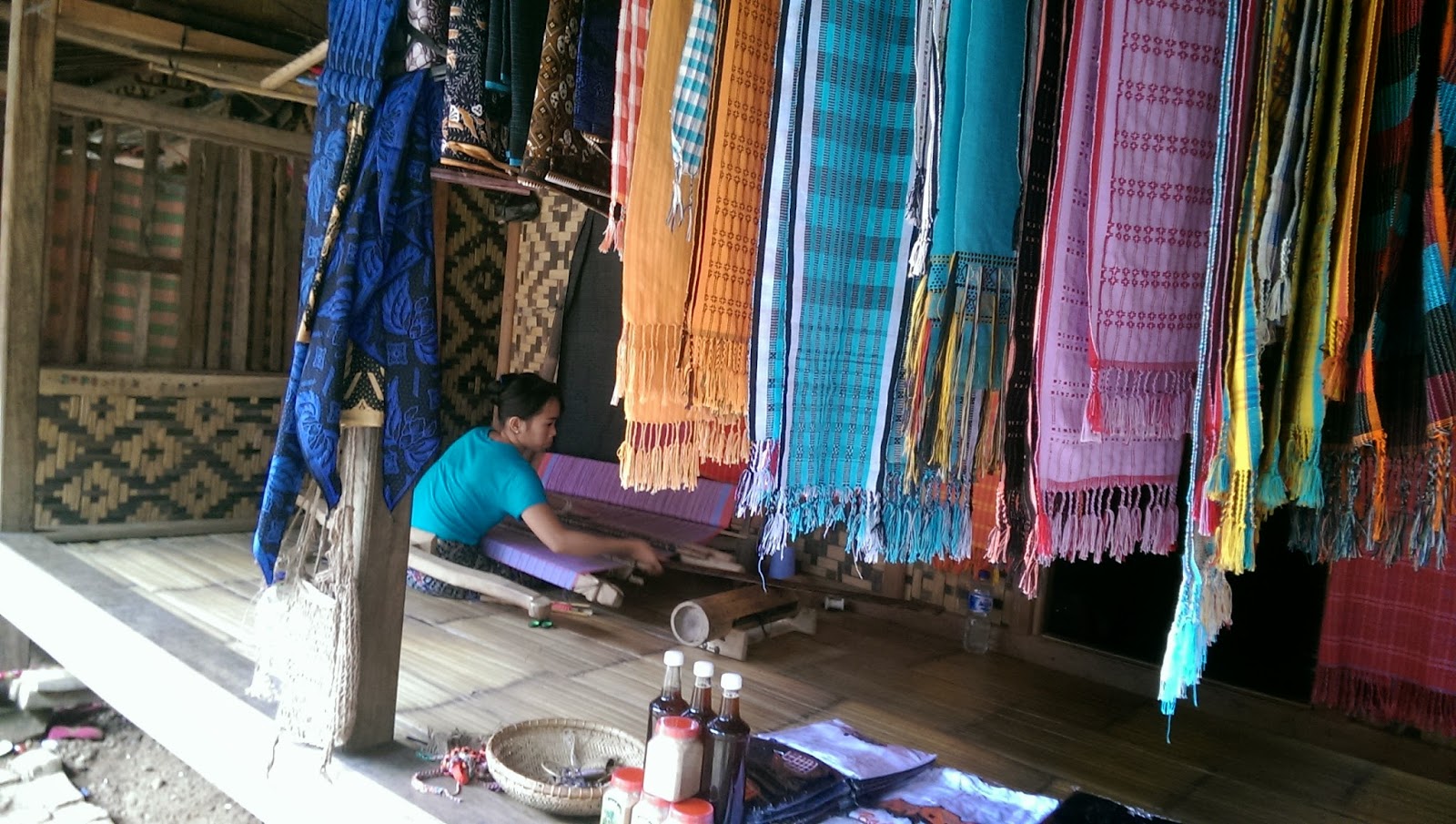
Initially, we moved along small traditional shops of Baduy Luar which displayed some tribal souvenirs, homemade honey and traditional hand-woven cloths. Some young women were at work to weave the colorful fabrics. Here and there, I could steal a glimpse of modern influence seeping into this place either by academicians, government or private enterprises in the so called corporate social responsibilities. A large welcome display bearing the name of one the biggest state owned bank greeted our eyes before entering.

The first hour hike up toward Gajeboh Village, which is one of the main villages where the people of the Baduy Luar live, was quite easy and fun under a drizzle. I did not have to wear my raincoat as I loved rain. It’s like playing under the rain. It’s interesting to observe the simple live around. The Baduy houses are uniformly simple, constructed only of natural materials, bamboo and palm thatching, without windows, and devoid of any furniture and furnishings. Small children played in front of the house, smiling wide and shy altogether. Every time, I approached them, they would ran and hide away. When I asked them question, they would timidly smile only and hide again. Some had some car toys to play with which was the sign that the tribe accepted the outside world influence. I was lucky to steal some shots of them. 

Leaving the Baduy Luar area, the trekking path was getting trickery due to the rain. It was hard enough to climb uphill, downhill and up again without a downpour. And with the pouring rain, the road became extremely muddy and slippery. Some from my group slipped and fell. Those who wore not trekking sandals had to say goodbye to their shoes and continued the trip barefoot. It was a struggle. Every muscle in your body worked! Yet, it was fun.

In some spots, we had to cross four or five traditional bridges made of bamboo. We had to carefully step on the bridge, lest we tripped and fell to the flowing river below. It made a creaking sound which made us jumpy and shaky. While trekking, we were surrounded by an abundance of beautiful scenery, such as natural green, the simple houses of Baduy tribe, the traditional barns, the coffee and clove trees. It’s so refreshing to inhale the smell of forest leaves and soil under the rain while listening to the sounds of the wild insects chirping. The surreal atmosphere was so soothing to the mind. The natural symphony was so relieving, a cure to the aching body from the long onerous trekking.

Photos can be taken at the Outher Baduy area but upon entering Inner Baduy village, taking photos of any kind are forbidden. The mystical atmosphere surrounding the village is very present here, so taking care and heeding these customs care is well advised.

The Baduy Dalam consists of three villages, Cibeo, Cikartawana and Cikeusik, each of which has a `Puun` or influential king or tribal chief. The Puun from Cikeusik are the most highly respected. The Puun spreads the teachings of their ancestors in preserving their traditions, ways of life and in caring for nature as the source of life. The visitors are mostly welcomed in Cibeo village.

After long 4 hours trekking, we arrived at the Cibeo Village. I was lucky to reach the site just before sunset so we could still clearly see our path. Some had to struggle under the dark. Our host welcomed us with their hospitality which was quite relieving. Unbearable with our sticky sweat and soil, my new friend and I, headed for the river with our flashlight. We thought we could soak our body in the deep clear crystal water, but to our disappointment, the river was so shallow. The deepest only reached to our calves. It was an open river and no building whatsoever to change clothes. Desperate, we relied on the dark to disguise our body, and just lied flat on the river bed for a minute or two. It seemed taking a bath in this river required only a dip into the river where the water was clean, cool and refreshing. It was forbidden to use soap or toothpaste while taking bath. The night has disguised us well and we were thankful for it.

This small stream is apparently the source of activity for this tribe. They do their laundry, washing, bathing and other toiletries activities in here. They also use this water as their source of cooking. In the morning, women clad in white and black, washed their dishes and clothes. Some lined up for toiletries. I could see they bring big frying pan and other kitchen utensils. Our host also had a European knife to peel off an apple. I guess bit by bit they started to accept using modern appliances.

There was no electricity in the house. The room was lit by coconut oil fuel as fire lamp and candles. Our host cooked the noodles, canned sardines and rice we had brought in their traditional stove lit by forest woods. The room was only divided by a kitchen and the front hall we slept in. There was no furniture whatsoever. All houses had the same structure so it was quite difficulty to differentiate them. I got astray several times from the river.

Several Baduy Traders stopped by at the house to offer us Baduy souvenirs, honey, clothes and mineral waters and other soft drinks. Basically, we did not have to step out of the house to get any items we wanted. It apparently the Baduy people has taken the benefits of the flourishing tourism business to help them finance their daily needs. As their numbers multiplied each generation, relying on the natural resources seem unable to cope up with the growing mouths to feed. They need to import their rice and other main necessities from Baduy Luar or Ciboleger.

I asked the guide on their produce specifically on rice, he said that Baduy people could only harvest paddy once a year. They grow a specific paddy variety which suit to their environment that relies heavily on the rain for irrigation. They store their paddy in the barn and it is forbidden to sell it. They only consume it for special feasts or occasion while for daily needs, they buy the rice from outside. 

Asked on where they keep their money if they have profits from selling their produce and tourism, he said they gave the money for safekeeping to the people of Baduy Luar they trusted. This agent functioned as a bank in which the depositors could withdraw the money anytime and the agent could invest the money for profit. He said Baduy Dalam is prohibited to save money in the bank.


Another interesting things I learn from the guide is that they do not know the term of dating to look for their future spouse. Their marriage is arranged at birth. The children do not attend school. Their parents and seniors are the responsible parties to teach them how to write and read. Formal education is against their traditional customs and the reject the government proposals for building educational facilities in their villages. As a result, only few Baduys are able to read and write. They do not play like us. They come with their parents to work at the farm. They play traditional music only.

When reaching adults, the men can venture outside territory of the Baduy Tribe as far as Jakarta. They still have to wear their skirt (trousers are prohibited), headbands and carry their machete and white cloth bag. Yet, they are strictly forbidden to take any means of transport. They have to reach Jakarta by foot. They reach the city after two days journey and stay at their friends’ home for more than 2 weeks in a visit. One guide disclosed to us that in here, they can watch TV, listen to music, taking a stroll in the malls and watch cinemas. Asked how they inform their friends that they would visit them, he told us that they borrowed the phone from their friend at Baduy Luar. Asked the reason why they visit the city, he said going to city was a sort of recreation for him.

Despite the modern city’s life, he told us he loved his village and tribe. It was his home. It was his vein of living.

I could see the great difference between our guides who have come to Jakarta dozens of times to those who haven’t ventured outside their land. Kang Sarta is full of self confidence, more elaborate in speaking and knowledgeable to some extent. His colleague who have ventured outside even spoke some English words with full of confidence. He read and write well, keeping a small diary containing phone numbers and addresses of his friends. While Kang Herman, who has yet to initiate his journey to the other world look shy, quite and hard to communicate. He often withdrew himself from a conversation in a timid style.

Last but not least, the role of women in this tribe seem so limited in the kitchen, farm and caring for the children. I did not see any women engaging in lively conversation with the visitors. Even, our host mostly watched us from a distance, speaking when we address her. It’s sad but it’s a case in most traditional tribes in other region.

All and all, it is worth living a day in this secluded village which reject modernization. There are many local wisdoms we all can learn from them. One of them is how to live in harmony with Mother Nature. It is imperative to respect nature as we cannot survive without its generous gift of abundance resources.